- The Curious Quill
- Posts
- Changing Jobs - When and How?
Changing Jobs - When and How?

Dileep Karri
January 11, 2024

Planning your career involves answering 3 questions:
How do we decide when it is the right time to make a career change?
How do we increase our chances of getting hired?
How do we crack interviews and get hired?
Right time for career change
Our career is a journey. Finding the right time to shift jobs and chase a new opportunity might be challenging.
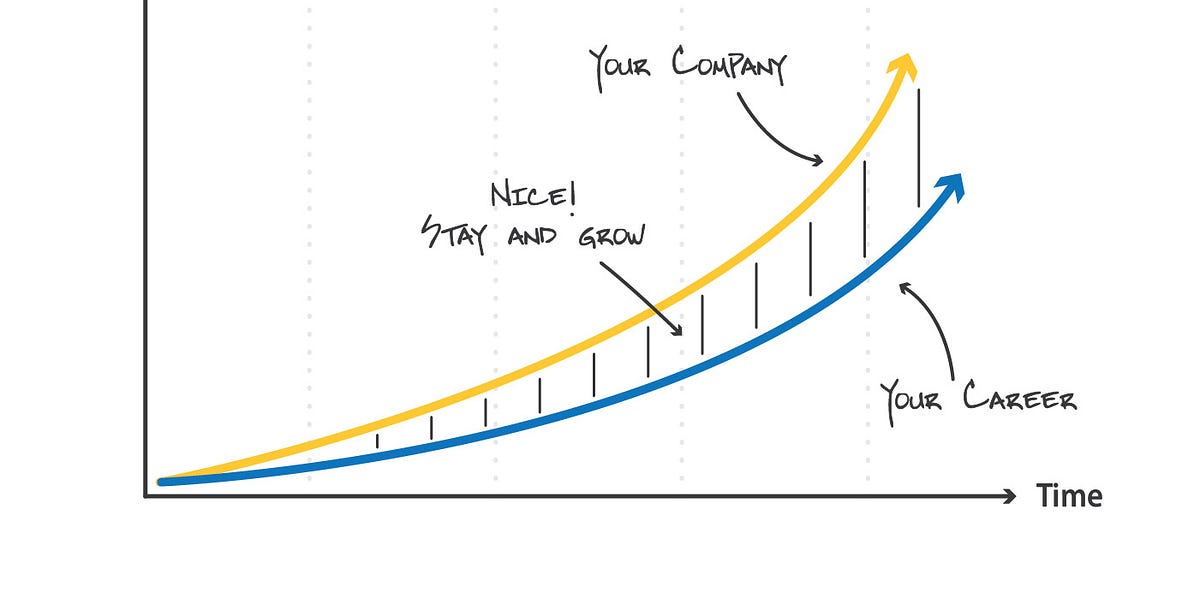
Having an excellent framework to help make this decision is ideal. A simple career framework is to compare our growth with the employer's growth. In a perfect situation, the growth rates must match closely (with the employer growth rate slightly ahead.) In either case, if we outgrow the company or the company outgrow us, we need to leave.
As we grow, the scope of work increases. We receive less guidance and are asked to solve more significant problems (and receive promotions too). In a short time, we gain expertise. The company must feed us new and exciting issues to keep us engaged. The company needs to grow at the same rate as us or slightly faster to keep challenging us. Else, it is time to move on.
Here, even the management must agree we are growing fast. When we exit, it must be due to the company's growth and no difference in opinion on performance.
The opposite can also happen. The company grows faster than we can cope. The team is expanding; new processes are coming up, and goals are shifting. We are asked to build teams and assume leadership we aren't ready for—it's time to move. The only metric to consider is our growth w.r.t the company for making a job change. Generic advice like - 'don't move around too much' or 'stay put for at least 2-3 years' does not apply.
We shouldn't jump ship at the first sign of trouble. Solving the problem is a great career win. At the same time, we must not feel too bad at recurring troubles - accept that it is time for the next opportunity. Determining the right time to move is challenging, but not moving at the right time might cause us to stagnate. A regular career audit and what we feel at different years helps.
A few questions that can help
Accomplishment: Have I done anything remarkable in the last quarter?
Impact: Will my work create such an impact that I would feature in my resume?
Growth: Have I acquired valuable skills aligned with my future goals?
Challenge: Have I been challenged with an exciting problem that made me think a lot?
Community: Am I excited and happy to work and align with the company's vision?
A yes to at least 3 out of 5 questions means we can stay put. The questions might vary from person to person. There are no right questions. There are only questions that feel right to us as we evaluate our careers. Change can also mean switching roles or teams, and our excitement returns. Changing jobs is completely fine. We are not bound for life.
But we need to do it in the right manner. It is a small world, and we are bound to cross paths. Be respectful without burning the bridges, and move on.
Let us say we decided it is time to move; how do we increase our chances of getting hired?
Getting Hired
Three things to remember:
Like ads, candidates like us compete for the same job. The more appealing we look, the better our chances.
The company needs us as much as we need the company.
Hiring is imperfect. Expect a few good offers to fall through the cracks.
What not to do?
Send a short email with curt text like, - 'I want a job'
Keep spamming recruiters with persistent messages.
Apply where we don't meet most of the JD must haves. (If at least 50% match, then only apply.)
Cold email: If we don't have a great network to tap into, we can write artful cold emails to potential employers. This template has a good chance of helping get noticed.
1/ The Ultimate Cold Email Template (@tferriss)
When Tim was writing his first book, he had no experience in publishing so he reached out to successful authors via email for advice.
Tim's email template worked incredibly well and Alex asked for it.
Here it is:
— Alex & Books 📚 (@AlexAndBooks_)
11:55 PM • Dec 21, 2020
Here are a few points to increase the chances of getting hired:
We are our brand. We need to market ourselves. Build a personal landing page explaining our journey. It's very easy to set up on Notion.
Have verifiable and demonstrable proof of work. Good examples are a blog or newsletter or deployed app on the cloud/GitHub repo. Put in the hard work here. This has asymmetric dividends.
Funnel approach:
Top of Funnel - all companies where we applied.
Middle of Funnel - where we are shortlisted.
Bottom of Funnel - cleared a few rounds and in final stages.
This is when we have no network and not sure where to work.
Sharp shooting approach: We have a good network and we know where to apply. This is a short list to begin with. Imagine what our day 1 with the company would be like and show a glimpse.
The idea is to stand out. Whatever we do, as long as we get a foot in the door, it is good strategy.
Crack Interviews and get hired
Here I bring perspectives from both sides - of hiring people and getting hired.
Prepare for the interview well. Refer to the thread below. It has been written for tech roles but can be extended for other roles. Without good prep, the rest of the advice does not matter.
Quick and (mostly) painless steps to making a technical interview study plan. 👇
— Randall Kanna Franson (@RandallKanna)
12:25 AM • Jul 30, 2020
What is the interview for?
See if we can think critically and solve problems.
Validate what we claim we have done on the resume.
Check if we are a good cultural fit.
Check our grit and persistence.
The rest is just window dressing. If we don't know the answer to a particular question, it is a good practice to try to reason through first principles.
Don't give up. The true interview starts when we say we don't know. The answer doesn't matter (as long as it isn't a basic question). Thinking does.
There are a lot of resume tips out there. One critical advice: Don't bluff about things you have not done. Don't hide things you have achieved. More tips to improve your resume:
How to improve your resume quickly in ANY (really!) amount of time. 🧵
— Randall Kanna Franson (@RandallKanna)
3:19 AM • Jul 28, 2020
Understand the company before the interview. Do proper research about the company and, if possible, the interviewer. Ask questions about work and management style to show genuine interest in the position. The greatest asset for a company is a gritty employee who figures out ways to get things done. We must showcase this aspect in our resume and portfolio, like how we tackled tough problems and made a difference.
Take-home challenge: The problem given is generally hard. It is not about solving the problem completely. It is about showcasing our thinking. In the limited time given, attempt a solution as far as possible. Then, show what else can be done given more time.
Salary negotiation: A low offer isn't an end; it's a starting point for a strategic negotiation.
If an offer or raise is less than expected, don't assume the company doesn't value you. Ask questions to understand why - budget/skill. Knowing the reasons empowers you to negotiate better.
The following lines can help open the conversation for further discussions:
I appreciate the offer, but I was hoping for a higher salary. Please share how you arrived at this number so that I can understand.
While I'm grateful for the offer, it's lower than we discussed. Could you provide some insight into how it was determined? I want to clarify any areas of concern so we can negotiate effectively.
Thank you for the offer. I know it's likely tough to meet everyone's expectations. What factors led to it falling short? Addressing those would help us find common ground.
I have exceeded performance expectations and helped launch products faster. Based on my market research, I believe that warrants a higher salary. What are your thoughts on increasing the offer to the number I proposed? I'm open to discussing options.
Here are a few red flags:
downplaying the salary requirements.
not clear about the role and roadmap ahead of the company.
absence of a strong mentor under whom we can learn more.
interview process relies more on memory than our thinking.
PS: Will keep updating this article every 6 months or so with new thoughts and learning.
References and additional reading:



Would bet that literally no one has sent typical CEO: “Here is a properly scoped internship project and here is the Day One output. Are you interested in seeing Day Two?”
— Patrick McKenzie (@patio11)
4:05 PM • Dec 30, 2020